

Patient Stories

A partner through amniotic band syndrome: Jace’s story
Jace is a happy, energetic 9-month-old whose big brown eyes light up a room. He’s adored by his parents, Kait and Evan, who not only delight in being first-time parents but are also incredibly appreciative of the care that helped save their son. It was care that took a village, Kait and Evan say — ... Read More about A partner through amniotic band syndrome: Jace’s story
Patient Stories

Whether she’s embracing school, sports, or music, Lindsey shows how Williams syndrome can be managed
One of the first things Lindsey Franco will tell you is, “I like being me. I like being happy.” The 19-year-old has a lot to be happy about. She attends a post-high school transition program that helps young adults expand their social and life skills. There, she does all the things she enjoys, including playing ... Read More about Whether she’s embracing school, sports, or music, Lindsey shows how Williams syndrome can be managed
Clinical Care

Nurse-led innovations: A virtual-nursing pilot helps nurses thrive
It was night shift on the 9E Inpatient Medical Unit and Marisol Hernandez, BSN, RN, CPN, was helping another nurse review her patient assignments. With about 85 percent of their patients admitted from the emergency department (ED), nurses on the unit at Boston Children’s Hospital often don’t know how many patients will be admitted during ... Read More about Nurse-led innovations: A virtual-nursing pilot helps nurses thrive
Research

First-of-its-kind clinical trial aims to improve outcomes in pediatric transplant patients
For the last 20 years, pediatric kidney transplant patients have been treated with the same immunosuppressive medication combinations and have been monitored using the same tests, without many new treatment options. Unfortunately, unlike their adult counterparts, pediatric transplant recipients have not been included in clinical trials to test newer and promising combinations of medications that ... Read More about First-of-its-kind clinical trial aims to improve outcomes in pediatric transplant patients
Clinical Care
In a thriving gene therapy program, nursing leadership is the driving force
Gene therapy was made possible by decades of technological advances. But to execute gene therapy at scale? That would not be possible without the foresight, organization, and innovation of nursing leadership at Boston Children’s Hospital. The gene therapy implementation framework they have built has become a gold standard for the field. Founded in 2010, the ... Read More about In a thriving gene therapy program, nursing leadership is the driving force
Research
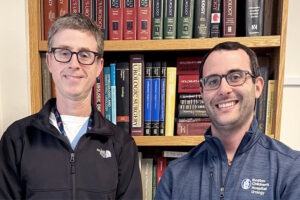
Simulation-based training program improves evaluation of undescended testicles
Could a lifelike manikin torso help improve pediatricians’ understanding of undescended testicles? That’s the hope of Eric Bortnick, MD, a fellow in Boston Children’s Department of Urology whose new simulation- and video-based educational tool aims to improve the diagnosis and management of this condition. Also known as cryptorchidism, undescended testicles are common congenital anomalies in ... Read More about Simulation-based training program improves evaluation of undescended testicles
Patient Stories

Guided by her own experience, one mom navigates Stickler syndrome with her children
Aimee is more than just Mum to three-year-old Arwen and one-year-old Cedric; she’s their guide to navigating Stickler syndrome, a genetic connective tissue disorder that can cause an underdeveloped jaw and airway obstruction (collectively known as Robin sequence), as well as cleft palate, vision and hearing difficulties, and other findings. As a carrier herself, Aimee ... Read More about Guided by her own experience, one mom navigates Stickler syndrome with her children
Patient Stories

‘Part of the process’: How a second opinion helped Wynn take control of bladder function
Wynton “Wynn” Smith-Webb is “the most inquisitive kid you’ll ever meet,” laughs his mother, Amber. At just 3 years old, he’s intrigued by science, nature, travel, and even medicine. It’s a mindset he might have picked up from Amber, a professor who says she lives “knee-deep” in data every day. So when Wynn recently began ... Read More about ‘Part of the process’: How a second opinion helped Wynn take control of bladder function
Research

Optimal care, lower costs: Examining the benefits of out-of-network care for pediatric moyamoya
Moyamoya disease is a rare condition that affects the blood vessels in the brain, especially in children. Narrowing and blockage of vessels significantly increases the risk of stroke and requires surgical revascularization for treatment. Although research shows that outcomes of revascularization are better at high-volume centers, insurers often hesitate to approve out-of-network care. However, a ... Read More about Optimal care, lower costs: Examining the benefits of out-of-network care for pediatric moyamoya
Patient Stories

Jumping higher, spinning faster: Max’s figure skating story
Thousands of fans around the globe have watched it, but very few people can do it. The quadruple Salchow, also known as the quad, requires that a skater launch themself into the air, spin four times, and land on one leg — ideally without falling or wobbling. The best figure skaters make skills like the ... Read More about Jumping higher, spinning faster: Max’s figure skating story