

Clinical Care
2020, the year COVID-19 tuned us into science: Part 3
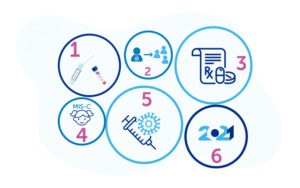
Since the arrival of a new, unknown, dangerous virus in January, we entered the realm of COVID-19 science. Part 1 and Part 2 of this series recapped what we learned about how the virus spreads, how to test for it and treat it, and how COVID-19 plays out in children. This month, vaccines began to be ... Read More about 2020, the year COVID-19 tuned us into science: Part 3
Clinical Care
2020, the year COVID-19 tuned us into science: Part 2
Thanks — or no thanks — to COVID-19, 2020 has been a year in which science became a household topic of discussion. Our last post recounted what we collectively learned in the spring: what COVID-19 is, who is at risk, how to test for it. As the year unfolded, there were new lessons to be learned. ... Read More about 2020, the year COVID-19 tuned us into science: Part 2
Clinical Care
2020, the year COVID-19 tuned us into science: Part 1
On January 9, the World Health Organization announced a mysterious pneumonia in Wuhan, China. Few people knew it was the threat infectious disease experts had feared for decades: a fast-spreading, potentially deadly new virus with no known cure. As the first images of critically ill patients came out of China and Italy, we watched as ... Read More about 2020, the year COVID-19 tuned us into science: Part 1
Clinical Care

New health care data-sharing rule, coming in 2022, has its roots at Boston Children’s Hospital
Are you sick of health care systems not communicating with each other? Do you wish you could access more of your medical information — or your patients’ information — online? Do you ever wonder whether a health pattern you see is part of a larger trend? Two key developments have advanced the vision of seamless, ... Read More about New health care data-sharing rule, coming in 2022, has its roots at Boston Children’s Hospital
Health and Parenting

Zooming in on screen time for children with special education needs
In 2013, the American Academy of Pediatrics recommended no more than two hours of screen time per day for school-aged children. This includes time on television, computers, tablets, and cell phones. However, during the current COVID-19 pandemic, many children are doing some, if not all, of their schooling remotely via a screen. So, how do you ... Read More about Zooming in on screen time for children with special education needs
Patient Stories
It’s personal: How the Boston Children’s progeria research community brought new life to an old drug
In late November, the U.S. Food and Drug Administration (FDA) approved a repurposed cancer drug called lonafarnib to treat Hutchinson-Gilford progeria syndrome, better known as progeria — an ultra-rare incurable genetic disease associated with rapid aging. On average, children with progeria die before age 15, usually the result of rapidly accelerated atherosclerosis resulting in heart ... Read More about It’s personal: How the Boston Children’s progeria research community brought new life to an old drug
Clinical Care
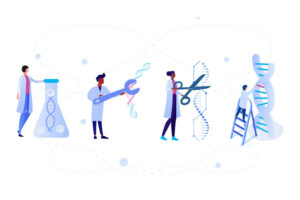
After decades of evolution, gene therapy arrives
As early as the 1960s, scientists speculated that DNA sequences could be introduced into patients’ cells to cure genetic disorders. In the early 1980s, David Williams, MD, and David Nathan, MD, at Boston Children’s Hospital published the first paper showing one could use a virus to insert genes into blood-forming stem cells. In 2003, the ... Read More about After decades of evolution, gene therapy arrives
Research
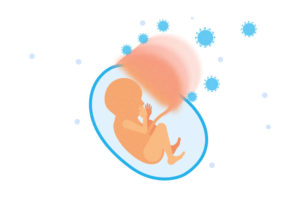
How does the placenta protect unborn babies from COVID-19?
Evidence has shown that pregnancy is a risk factor for severe illness in women with COVID-19. A recent CDC study reviewed case reports of approximately 400,000 women aged 15 to 44 with symptomatic COVID-19. Those who were pregnant had a roughly tripled likelihood of ICU admission and invasive ventilation and 70 percent higher mortality. Yet ... Read More about How does the placenta protect unborn babies from COVID-19?
Patient Stories
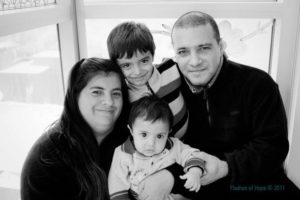
A rebirth in Boston: Gene therapy turns 10
Lea la versión en español. Dec. 17 marks a decade since Agustín Cáceres was “renacido” — reborn. That’s how his parents, Alberto and Marcela, describe the day their son received his new gene. Born in 2010 with X-linked severe combined immunodeficiency (SCID-X1), Agustín spent the first few months of his life in isolation, at home ... Read More about A rebirth in Boston: Gene therapy turns 10
Clinical Care
In-hospital telehealth: Care innovation during the COVID-19 pandemic
The quick response, or QR, code — that square barcode symbol used by smartphone apps to link users with specific information — became an unexpected but essential tool for patient care at Boston Children’s Hospital in early spring. When the first patients with COVID-19 arrived, it quickly became clear that health care providers needed safer ... Read More about In-hospital telehealth: Care innovation during the COVID-19 pandemic