How Wyatt became the smallest baby to undergo PDA closure at Boston Children’s
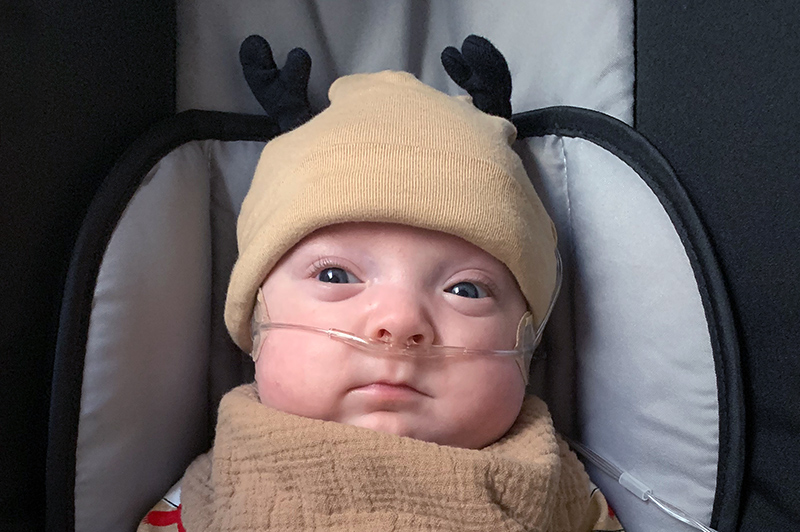
In June 2023, at 22 weeks pregnant, Madisen went into labor with twins.
Her care team in New Hampshire transferred her to a maternal-fetal medicine center in Boston in hopes of delaying delivery, but Gavin and Wyatt arrived within hours.
“Things just evolved quickly,” Madisen says. “I delivered Gavin first, and Wyatt about two and a half hours later.”
Born more than four months early, the boys were much smaller than they would have been at full term — Gavin weighed 1 pound, 1.5 ounces, and Wyatt weighed 1 pound, 0.4 ounces. Their level of prematurity also meant they needed highly specialized care.
Prematurity and early complications
In addition to low birth weight, premature infants often face significant challenges because their organs haven’t had enough time to fully develop. For these babies, neonatal intensive care units (NICUs) provide support for breathing, feeding, and growth as their bodies continue to develop. Gavin and Wyatt were immediately admitted to their birth hospital’s NICU, where they faced extra obstacles tied to their extreme prematurity, including a patent ductus arteriosus (PDA), which occurs when the ductus arteriosus (a fetal blood vessel in the heart that normally closes shortly after birth) stays open, letting blood flow the wrong way from the body to the lungs.
For some infants, a PDA closes on its own or with medication, which happened for Gavin. Wyatt’s, however, did not close. It was also large and affecting his heart and circulation, which raised concerns that without intervention, his condition could worsen.
Weighing the risks and benefits of PDA closure
Because of the size and impact of Wyatt’s PDA, Madisen and her husband, Dylan, were referred through a coordinated care process to Boston Children’s Premature Patent Ductus Arteriosus Closure Program, where they met with program directors Dr. Michael Farias and Dr. Philip Levy to review treatment options.
“For babies born extremely premature, treating a PDA can be especially challenging,” says Dr. Farias. “Traditional surgical closure requires opening the chest, which is a major procedure for any infant, but even riskier for those who are so small and medically fragile like Wyatt.”
At the time, Wyatt weighed just over one pound.
Boston Children’s was among the first centers in the country to develop expertise in transcatheter PDA closure in premature infants, a minimally invasive approach that uses a tiny device delivered through a blood vessel to seal the opening in the heart without open surgery. Once in place, the device redirects blood flow so the heart and lungs can function more efficiently as the infant grows. Wyatt was the smallest infant ever considered for the procedure at Boston Children’s.
“Wyatt’s size certainly made the procedure more complex,” says Dr. Farias. “But it wasn’t so much about the numbers on the scale; it was about how his heart and lungs were functioning. The strain on his system meant that closing the PDA offered the best chance to stabilize his condition and support his ongoing development.”
“There was a lot of discussion about the pros and the cons and learning about how the device would work,” Madisen says. Together with the Boston Children’s team, Madisen and Dylan ultimately felt the catheter-based approach offered Wyatt the best chance of stabilization without open surgery.
On July 3, at 2 weeks old, Wyatt underwent transcatheter PDA closure.
Recovery and ongoing NICU care

Following the procedure, Wyatt joined his brother in the NICU for continued recovery and monitoring. Both he and Gavin continued to receive care as they grew and developed, including respiratory support, feeding advancement, and close observation.
At the end of November, after 164 days in the hospital, the boys came home.
For Madisen, that milestone was nonnegotiable.
“I wanted them home for the holidays,” she says. “And I wanted them home together.”
Growing beyond the NICU
In the earliest months home, the boys were still closely tied to Boston Children’s, with frequent follow-up visits across multiple specialties. Over time, though, the appointments began to space out as they grew and became more stable. Dr. Farias and the PDA closure team will continue to monitor Wyatt as he grows, though they don’t expect to see him limited in any way. Which is good, because today Wyatt’s a very energetic preschooler who loves bikes, climbing on everything he can find, and keeping up with his brother.
“He’s doing great,” Madisen says. “He’s active like crazy.”
“They’re both so full of life,” she says of her sons. “They’re really miracles.”
Learn more about Boston Children’s Premature Patent Ductus Arteriosus Closure Program.
Related Posts :
-

PDA transcatheter closure in preemies
The problem of how to close a patent ductus arteriosus (PDA) in premature babies is not new. Medications don’t ...
-
The 'Trach Chapter': Isabella’s journey with bronchopulmonary dysplasia
Isabella’s life has been anything but ordinary. Born at just 27 weeks gestation and weighing only 1 pound, 4 ounces, Isabella has ...
-
Mending injured hearts: Lessons from newborns?
When the heart is injured, as in a myocardial infarction, the damaged heart muscle cannot regenerate — instead, scar tissue forms. ...
-
Sunshine and swimming: Patrick’s fun life after a minimally invasive thoracotomy for AV canal defect
Life had seemed normal for Patrick* and his family in June 2025. He celebrated his second birthday and was reaching all ...