Finding answers and care for a rare movement disorder: Aisha’s experience with deep brain stimulation
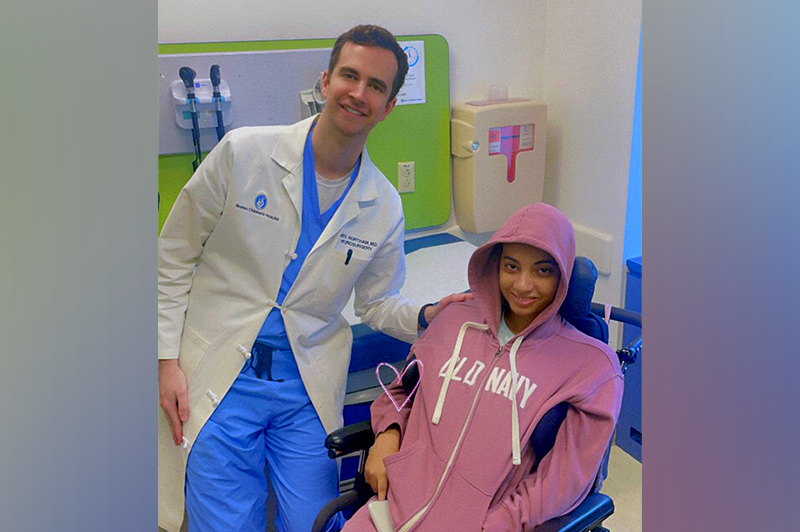
For nearly a decade, Aisha’s family looked for answers about a disease they couldn’t name.
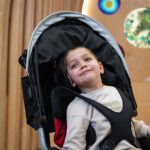
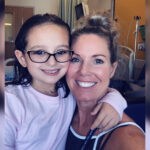
Born in Bahrain in 2006, Aisha was about a year old when her mother, Mariam, noticed involuntary movements in her face and lips. As she grew, Aisha showed delays in walking, speech, and other developmental milestones. Despite years of appointments and testing in Bahrain and abroad, no one could say with certainty what was causing Aisha’s symptoms. Then, in 2015 — at a friend’s suggestion — they contacted the Movement Disorders Program at Boston Children’s Hospital.
Mariam says Boston Children’s stood out not only for its work in diagnosing and treating rare movement disorders, but also because Aisha was connected almost immediately with specialists across the hospital to address her complex care needs.
Finding a diagnosis and understanding
At Boston Children’s, Aisha received genetic testing that unveiled she had ADCY5-related movement disorder (ADCY5-MD), a rare condition caused by mutations in the ADCY5 gene, which plays a key role in helping regulate signaling in the brain pathways that control movement. At the time, ADCY5-MD had only recently been recognized, and much about it — including how to treat it — was unknown.
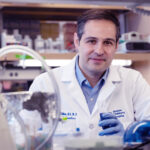
“When Aisha was diagnosed with ADCY5, there was still very limited experience worldwide treating patients,” says Dr. Darius Ebrahimi-Fakhari, pediatric neurologist and director of the Movement Disorders Program. “But over the last decade or so, our understanding has grown considerably.”
For Aisha and her family, that evolution in understanding shaped the next several years of their lives.
In 2021, they relocated to Boston so Aisha could receive ongoing multidisciplinary care, including a series of orthopedic procedures on her spine and legs to improve her mobility. At the same time, the Movement Disorders Program team continued to help lead advances in understanding movement disorders such as ADCY5-MD, including whether therapies such as deep brain stimulation (DBS) might be appropriate for Aisha.
DBS uses implanted electrodes to deliver carefully controlled electrical stimulation to specific areas of the brain involved in movement. It has been shown to reduce abnormal movements and improve daily function in some patients with severe movement disorders, including ADCY5-MD.
“For children like Aisha, the benefits of DBS can extend beyond reduced abnormal movement,” Dr. Ebrahimi-Fakhari says. “We see improvements in endurance, mobility, sleep, and overall quality of life.”
A turning point for considering DBS
For Mariam, DBS wasn’t an easy recommendation to accept.
“When DBS was first suggested, I wasn’t convinced,” she admits. “Aisha’s condition was still so new, and they were still learning about it.”
What helped change Mariam’s perspective was speaking with another family whose child had undergone DBS for a similar movement disorder. Their conversations allowed Mariam to ask questions, hear firsthand about a similar experience, and better understand what DBS could look like for her daughter.
“It gave me peace of mind,” Mariam says.
In 2024, Aisha underwent DBS. The results have led to meaningful improvements in her daily life. After years of struggling to maintain her weight because of constant involuntary movements, Aisha is now better able to support her nutrition. She has also gained mobility and has begun walking with assistance for the first time since she was a toddler.
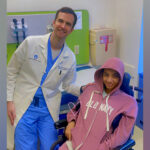
She continues to see the Boston Children’s team and expects to return for DBS evaluations in the coming year, but Aisha’s progress has allowed her family to move back home to Bahrain, where she recently completed high school and is preparing for college. She enjoys swimming, horseback riding, and going to the movies with her family and friends.
Paying it forward
Aisha’s experience has inspired the clinicians who care for her. In 2024, Dr. Darius Ebrahimi-Fakhari and Dr. Kathryn Yang launched DBSMatchMaker, a platform that connects clinicians around the world who are considering DBS for patients with rare movement disorders such as ADCY5-MD. The collaboration has already led to the first publication on DBS outcomes in ADCY5-related disorder, extending what was learned from a handful of patients to families and clinicians worldwide.
“Through the DBSMatchMaker network, experiences like Aisha’s are informing care for patients everywhere,” says Dr. Ebrahimi-Fakhari.
For Mariam, sharing their family’s story is about helping others facing the same uncertainty she once felt.
She remembers how frightening DBS sounded when it was first suggested and how much it meant to speak with other parents who had walked the same path; she wants to pay it forward.
“If our experience can help another family feel more comfortable,” Mariam says, “it’s worth sharing.”
Learn more about the Movement Disorders Program at Boston Children’s Hospital.
Related Posts :
-

Small gains with big meaning: Loic's story of deep brain stimulation for PKAN care
Loic, 5, lives in Montana with his parents, Sherine and Mark, and his sister, Selah. He loves Spider-Man, sushi, and the ...
-
The journey to a treatment for hereditary spastic paraplegia
In 2016, Darius Ebrahimi-Fakhari, MD, PhD, then a neurology fellow at Boston Children’s Hospital, met two little girls with spasticity ...
-
Lessons from Emma: Mom shares how RNS has changed their lives
Emma’s journey with the Epilepsy Center at Boston Children’s Hospital began three years ago when she came to ...
-
العثور على إجابات ورعاية لاضطراب حركي نادر: تجربة Aisha مع التحفيز العميق للدماغ
لقرابة عقد، بحثت عائلة Aisha عن إجابات لمرض عجزوا عن تسميته، بدأ منذ طفولتها المبكرة. ولدت Aisha في البحرين عام 2006، وكانت تبلغ من العمر عامًا واحدًا تقريبًا عندما لاحظت والدتها، Mariam، حركات لاإرادية في وجهها وشفتيها. ومع نموها، ظهر لدى Aisha تأخر في المشي والكلام والجوانب التطورية الأخرى. ورغم سنوات من المراجعات والفحوصات الطبية في البحرين وخارجها، عجز الجميع عن تحديد السبب الدقيق لأعراض Aisha. بعد ذلك، وفي عام 2015 — بناءً على اقتراح صديق — تواصلت العائلة مع برنامج الاضطرابات الحركية (Movement Disorders Program) في Boston Children’s Hospital. تقول Mariam إن مستشفى Boston Children’s تميز ليس فقط بجهوده في تشخيص الاضطرابات الحركية النادرة وعلاجها، بل لأن Aisha حظيت برعاية فورية تقريبًا على أيدي أخصائيين من مختلف أقسام المستشفى لتلبية احتياجات رعايتها المعقدة التشخيص وفهم الحالة خضعت Aisha في Boston Children’...