Small gains with big meaning: Loic’s story of deep brain stimulation for PKAN care
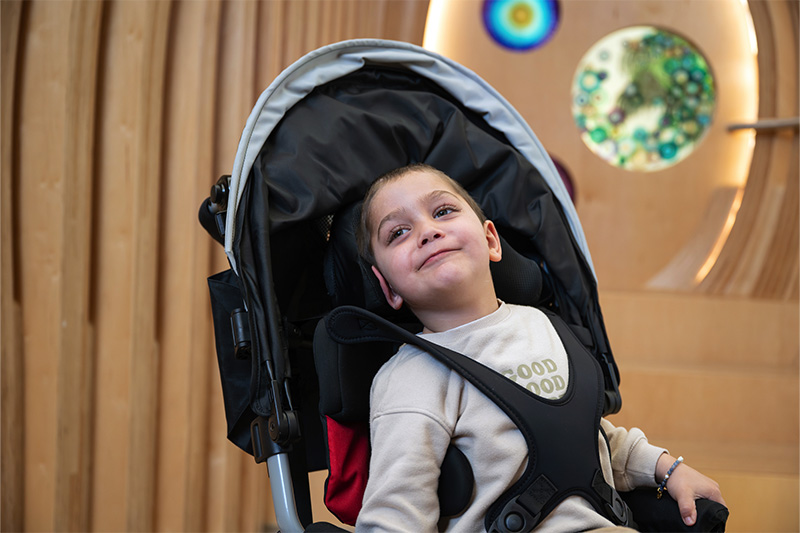
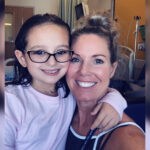
Loic, 5, lives in Montana with his parents, Sherine and Mark, and his sister, Selah. He loves Spider-Man, sushi, and the Fourth of July. He laughs easily, sings along to his favorite shows, and is a big flirt. These are the little things that Sherine says make Loic, Loic, and which, until earlier this year, were slipping away.
Early signs and genetic testing
As a baby, Loic seemed to be developing on track, sitting up and rolling over on schedule. When he was about 1 year old, Sherine and Mark noticed changes.
“He wasn’t babbling as much, he wasn’t moving as much, he wasn’t pulling himself up,” Sherine says.
Loic’s doctors ordered genetic tests to try to pinpoint a cause and guide his care. When those came up short on answers, Sherine and Mark pursued full exome sequencing, which revealed pantothenate kinase-associated neurodegeneration (PKAN), an extremely rare and life-threatening genetic disease.
PKAN prevents the brain from processing coenzyme-A, which is essential for energy and cell health. Over time, the condition causes dystonia — painful muscle contractions affecting movement, posture, and coordination — and can also impact speech, swallowing, and vision. There is no cure. The average life expectancy for a child like Loic is 10 years.
Sherine refused to accept this as the only outcome for her son.
“I couldn’t allow this to be the only path for him.”
Pushing for science and support
Sherine started a foundation to accelerate funding for a gene therapy for PKAN and she spent months contacting researchers and biotech companies to push the work forward. She also explored ways to support Loic in the moment, including medication, dietary changes, and supplements, which helped for a time. But last June, Loic started experiencing involuntary movement in his right arm, then his left. Over the course of the fall, he lost movement control throughout his body. In her search for ways to support Loic’s day-to-day life and manage the effects of PKAN, Sherine learned about deep brain stimulation (DBS) offered through the Movement Disorders Program at Children’s Hospital and led by neurologists Dr. Darius Ebrahimi-Fakhari and Dr. Kathryn Yang.
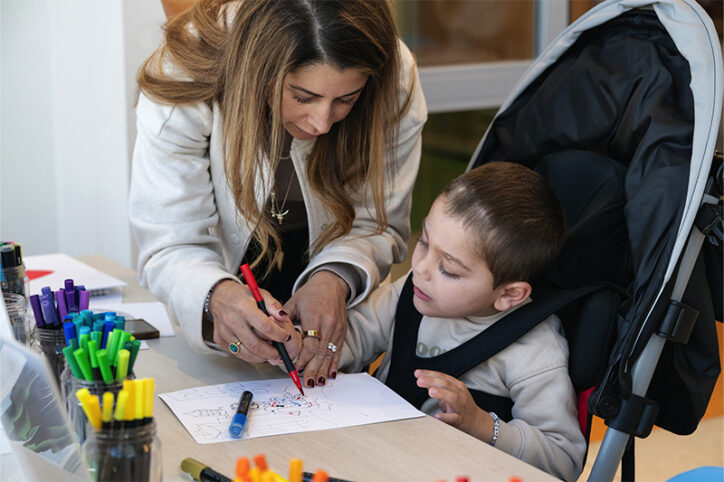
DBS can treat severe dystonia when medications aren’t effective. It’s not a cure for neurodegenerative conditions such as PKAN and does not slow their progression, but it can help regulate abnormal brain signals, reduce muscle contractions and improve a child’s comfort. DBS is also used to treat dystonia in children with conditions such as cerebral palsy, certain movement disorders, and some forms of epilepsy. The procedure involves implanting thin electrodes into areas of the brain that control movement (often the globus pallidus). These electrodes are connected to a small, pacemaker-like device that sends gentle electrical signals to help steady the brain’s messages and lessen involuntary muscle contractions.
“If we’re able to start DBS treatment in time, we may be able to regain months or even years of function,” says Dr. Yang.
Sherine spoke with pediatric movement disorder centers across the country about DBS and says what set Boston Children’s apart was their emphasis on a cautious, highly planned process that was customized for Loic’s young age and its unique complexities. This included carefully mapping Loic’s brain before surgery and using real-time imaging in the operating room to ensure proper electrode placement, followed by several weeks of monitoring and programming with the Movement Disorders team.
“They didn’t just say they could do it. They explained how and why,” Sherine says.
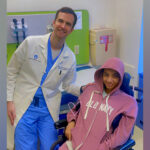
Loic and his family traveled to Boston in January. Within days, neurosurgeon Wes Northam performed DBS surgery.
“Our goal is precise targeting of the specific brain circuits controlling movement,” says Dr. Northam. “Even small differences in electrode placement can change how the stimulation works, and careful monitoring is essential to ensure it’s working as intended.”
Finding hope in small gains
Sherine and Loic stayed in Boston for weeks while the team monitored him closely and adjusted the electrodes to make sure they were delivering signals effectively.
“I wish it was like a switch that you turned on and it just immediately worked,” Sherine says. “But the changes have been small.”
Those small changes, however, have been meaningful. Loic can sit more comfortably; his body is more relaxed; and he has regained the ability to eat by mouth.
And, perhaps most importantly, pieces of his personality are coming back, including singing and laughing at his shows.
“It’s been hopeful,” Sherine says. “We’re hopeful.”
Learn more about the Movement Disorders Program at Boston Children’s Hospital.
Related Posts :
-

AI-enabled medical devices are burgeoning, but many haven’t been tested in children
Medical devices that incorporate artificial intelligence and machine learning are proliferating. In 2013, the FDA approved fewer than 10 such devices; by 2023, ...
-
Lessons from Emma: Mom shares how RNS has changed their lives
Emma’s journey with the Epilepsy Center at Boston Children’s Hospital began three years ago when she came to ...
-
Finding answers and care for a rare movement disorder: Aisha’s experience with deep brain stimulation
For nearly a decade, Aisha’s family looked for answers about a disease they couldn’t name. Born in Bahrain ...
-
العثور على إجابات ورعاية لاضطراب حركي نادر: تجربة Aisha مع التحفيز العميق للدماغ
لقرابة عقد، بحثت عائلة Aisha عن إجابات لمرض عجزوا عن تسميته، بدأ منذ طفولتها المبكرة. ولدت Aisha في البحرين عام 2006، وكانت تبلغ من العمر عامًا واحدًا تقريبًا عندما لاحظت والدتها، Mariam، حركات لاإرادية في وجهها وشفتيها. ومع نموها، ظهر لدى Aisha تأخر في المشي والكلام والجوانب التطورية الأخرى. ورغم سنوات من المراجعات والفحوصات الطبية في البحرين وخارجها، عجز الجميع عن تحديد السبب الدقيق لأعراض Aisha. بعد ذلك، وفي عام 2015 — بناءً على اقتراح صديق — تواصلت العائلة مع برنامج الاضطرابات الحركية (Movement Disorders Program) في Boston Children’s Hospital. تقول Mariam إن مستشفى Boston Children’s تميز ليس فقط بجهوده في تشخيص الاضطرابات الحركية النادرة وعلاجها، بل لأن Aisha حظيت برعاية فورية تقريبًا على أيدي أخصائيين من مختلف أقسام المستشفى لتلبية احتياجات رعايتها المعقدة التشخيص وفهم الحالة خضعت Aisha في Boston Children’...