Fighting for — and with —Kiara through congenital diaphragmatic hernia care
Although Andrea and Kevin hadn’t planned on having a third child, the news that they were expecting another baby was a welcome surprise.
“Every child is a blessing, so we were still very excited,” says Andrea.
But soon there was worrisome news: At her 20-week ultrasound, Andrea learned that her daughter Kiara would be born with a congenital diaphragmatic hernia (CDH). In this condition, a child’s diaphragm doesn’t fully develop in the womb, which allows abdominal organs to move into the chest, preventing normal lung development and leading to breathing difficulty.
“My mind went blank,” Andrea remembers. “It didn’t really hit me until later that day. I shut myself in my bedroom and cried.”
Learning what to expect with CDH
Once Andrea and Kevin had let the news sink in, they started researching CDH and its treatment, which typically involves surgical repair of the hole soon after birth. Andrea’s obstetrician referred her to Boston Children’s Hospital, where she and Kevin met the team at the Fetal Care and Surgery Center, who helped them prepare for what would happen after Kiara was born. They also met with surgeon Dr. Jill Zalieckas, co-director of the Congenital Diaphragmatic Hernia Center, to learn what to expect during and following the procedure.
| The future looks increasingly brighter for babies born with CDH. Those treated at our Congenital Diaphragmatic Hernia Center have an 84 percent survival rate. |
Although CDH is a serious condition, many newborns can be treated successfully, with an overall survival rate of 84 percent — news that Andrea found comforting.
“We read a lot of stories about kids whose situations were more severe, but who are doing well now,” she explains. “We knew that we would fight for Kiara as long as we could.”
An emotional wait
Kiara is a fighter herself. After a relatively quick delivery at her birth hospital, she was whisked away to Boston Children’s Medical-Surgical Intensive Care Unit (MSICU) for specialized care and monitoring as she awaited surgery. While Kevin was able to see her right away, Andrea had to wait several hours until she was cleared to leave her hospital bed. Kiara was tiny — just over 6 pounds — and intubated, but she was here. It was Valentine’s Day.
Four days later, it was time for surgery to repair her CDH. “It was the longest wait for us emotionally,” says Andrea. “But they told us everything went perfectly.”
Then came an even longer wait: After 12 days, Andrea and Kevin were finally able to hold Kiara, who recovered for almost 3 months in the hospital. The couple tried to find a balance while caring for their two older children. “We came up with a daily routine to make it work,” says Andrea. “We didn’t want to miss a day of being by her side.”
‘So determined’
Although Kiara initially had challenges with aspiration — a common concern in babies with CDH — feeding therapy has helped. That May, she was finally able to go home. “It was the best early Mother’s Day gift,” says Andrea.
It hasn’t always been easy. Kiara has since struggled with RSV, bronchitis, and other respiratory infections which have resulted in her being admitted to the hospital to recover. “That’s knocked her down, but she fights through it,” says Andrea. The ongoing support of Kiara’s care team, which also includes nurse practitioners Hannah Fraser and Lindsay Lemire, has also helped.
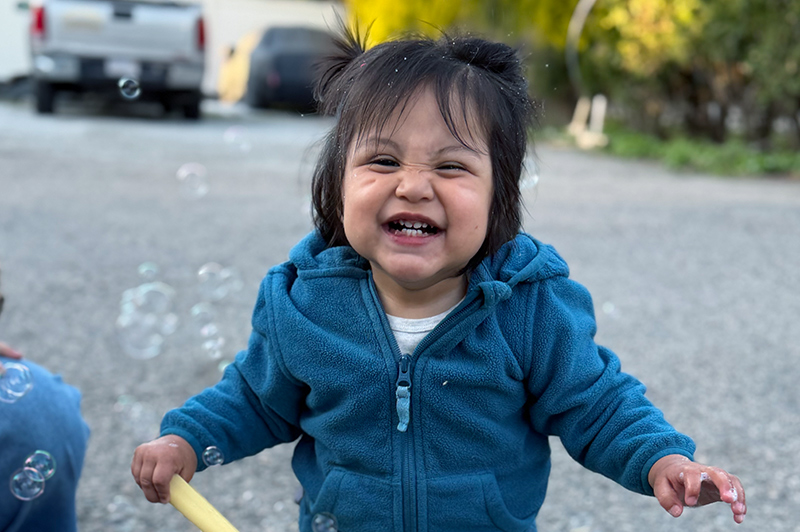
Now at only 18 months, Kiara still has occupational therapy and speech therapy and will start physical therapy soon. She’s taking it all in stride. “She’s very sassy and loves her brother and sister so much,” says her mom. Like many other toddlers, there’s one thing she doesn’t love, though: the word ‘no.’ “If she doesn’t like something, she’ll make a face and give us the side-eye,” laughs Andrea. “She’s so determined — it’s amazing.”
Learn more about our Congenital Diaphragmatic Hernia Center.
Related Posts :
-

The best decision: Triplet Jayden is thriving after CDH repair
Jayden is barely a year old, but he’s already been through more ups and downs than some adults. Born ...
-
‘Our silver lining’: Mila is thriving after CDH repair
For Katie, last St. Patrick’s Day wasn’t an occasion for revelry. Instead, it was the day an ultrasound ...
-
Making it through the fight: Scarlett's CDH journey
Like her name suggests, Scarlett Virginia Moulton “has a lot of fire,” says her mother, Olivia. “She always has a ...
-
Rh alloimmunization: A family’s experience across two pregnancies
After her second child was born 14 years ago, Erin was convinced she’d never have another baby. Not because of ...