Rh alloimmunization: A family’s experience across two pregnancies
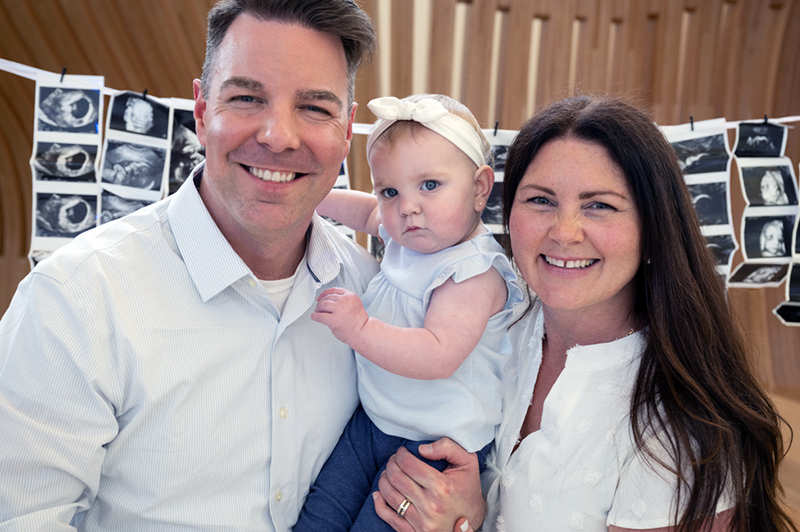
After her second child was born 14 years ago, Erin was convinced she’d never have another baby. Not because of her age or because she didn’t want to grow her family, but because of the painful prenatal experience that had stayed with her for years.
Erin had developed alloimmunization, a condition in which the immune system treats foreign blood as a threat and makes antibodies to fight it. In an Rh-negative pregnant person carrying an Rh-positive fetus, these antibodies can cross the placenta and attack fetal blood cells. This process can cause hemolytic disease of the fetus (HDFN), a condition that can lead to fetal anemia and other complications. Depending on the severity, treatment may involve intrauterine transfusions, in which doctors deliver compatible red blood cells to the fetus through the umbilical cord. Erin remembers the transfusions vividly.
“It was large needles, some medication to dull the pain, and then I was sent home,” she says.
The experience left such a lasting impression that Erin all but ruled out having more children.
“For a long time, pregnancy was completely out of the realm of things I thought I could ever do again,” she says.
Deciding to grow their family
Over time, though, Erin and her husband, Carl, kept returning to the same thought: they wanted another child.
They also knew the risks. Erin carried antibodies that caused severe fetal anemia in her last pregnancy, and because those antibodies remain in her body, future pregnancies are at higher risk for fetal hemolytic disease.
“The fear of the unknown is scary,” Erin says. “But the fear of the known was even scarier because I knew what was coming.”
She learned she was pregnant in late 2024. A few weeks later, routine bloodwork showed her antibody levels rising.
“I remember saying, ‘Here we go again,’” Erin recalls.
But this time would be different.
Erin’s obstetrician referred her to Dr. Cassandra Duffy, a maternal-fetal medicine specialist at Beth Israel Deaconess Medical Center and the Fetal Care and Surgery Center at Boston Children’s Hospital.
At Boston Children’s she and Carl met with Dr. Duffy and a multidisciplinary team experienced in managing complex fetal conditions such as alloimmunization, led by Dr. Eyal Kripin, fetal surgeon and director of the Fetal Care and Surgery Center. The team provided a clear plan and a sense of hope.
Erin remembers clearly, “Right away we felt heard and seen.”
A different care experience
Managing alloimmunization during pregnancy requires close monitoring, including specialized ultrasounds that measure blood flow in the fetal brain. When changes in blood flow signal anemia in a fetus, doctors may perform an intrauterine transfusion, using ultrasound to guide a needle through the maternal abdomen and into the umbilical cord.
For Erin, the procedures were familiar. The way they were handled at Boston Children’s was a far more comforting experience. Unlike her previous pregnancy years earlier, Erin’s transfusions took place in an operating room. She received medication to help her relax and was closely monitored afterward, sometimes overnight.
“Being in the operating room allows us to keep patients comfortable and be fully prepared in case additional interventions or delivery is needed,” says Dr. Duffy.
Carl says the team’s patience also stood out.
“I ask a lot of questions,” he says. “I wanted to know exactly what was happening with my wife and my child, and they never made me feel like that was too much to ask.”
Starting around 25 weeks, Erin and Carl visited the Fetal Care and Surgery Center almost weekly for ultrasounds and monitoring. Over time, they grew close with members of their care team, including their nurse, Meredith Cox.
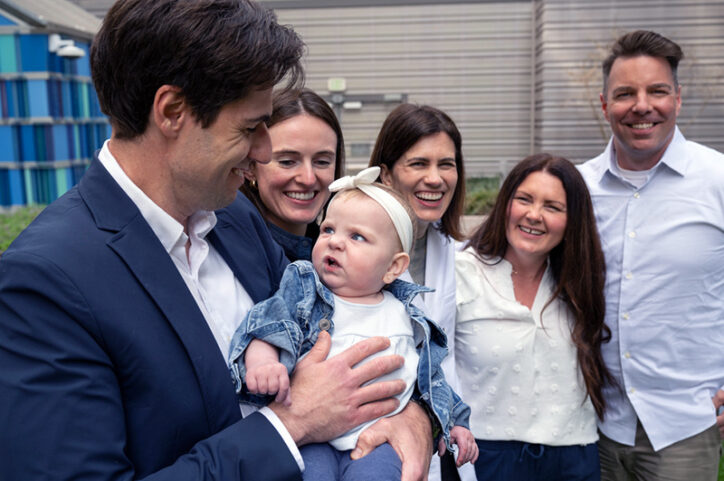
“She was such a source of comfort,” Erin says.
Reaching full term
In Erin’s previous pregnancy, she delivered at 34 weeks. This time, the goal was to safely reach later in the third trimester. Led by Drs. Duffy and Krispin, the team carefully timed each transfusion to allow Erin’s pregnancy to continue as long as possible.
“Avoiding prematurity and the complications that may come with it can make a big difference in a baby’s health and development,” says Dr. Duffy.
In June 2025, after four intrauterine transfusions, Charlotte was born at 37 weeks.
She spent 23 days in the neonatal intensive care unit receiving treatment for jaundice and underwent two transfusions for mild anemia. Erin says the difference after each transfusion was noticeable.
“You could see it in her color and her energy,” she says. “She’d be a different baby within hours.”
Charlotte was followed by specialists at the Blood Disorders Center at Dana-Farber/Boston Children’s until her red blood cell levels stabilized and she no longer showed signs of anemia; she “graduated” from hematology care after four months.
Today she’s thriving. She’s meeting all her milestones, is adored by her two older sisters, and has developed a love of minestrone soup.
“She’s perfect,” Carl says.
Learn more about the Fetal Care and Surgery Center at Boston Children’s Hospital.
Related Posts :
-

Choosing fetoscopic spina bifida care for Hadley
When Katie and Derek learned in 2024 that their daughter Hadley would be born with spina bifida, they quickly set out ...
-
‘Zero place for mistakes’: Taking fetal surgery to the next level with simulation
The highly complex interventions involved in fetal surgery require exceptional skill, training, and experience. Beyond the procedures themselves, these surgical ...
-
Living fully: Kristin’s life with blue rubber bleb nevus syndrome
More than 25 years ago, I spent 11 hours in surgery while a surgeon removed hundreds of abnormal blood vessels from my ...
-
A reunion of the heart: Grace and Amy bond through HLHS
At first glance, Grace and Amy have a pretty typical friendship: they joke around, cheer each other on, and keep ...