Finally a chance to breathe: Christiana gets care for Hirschsprung’s disease
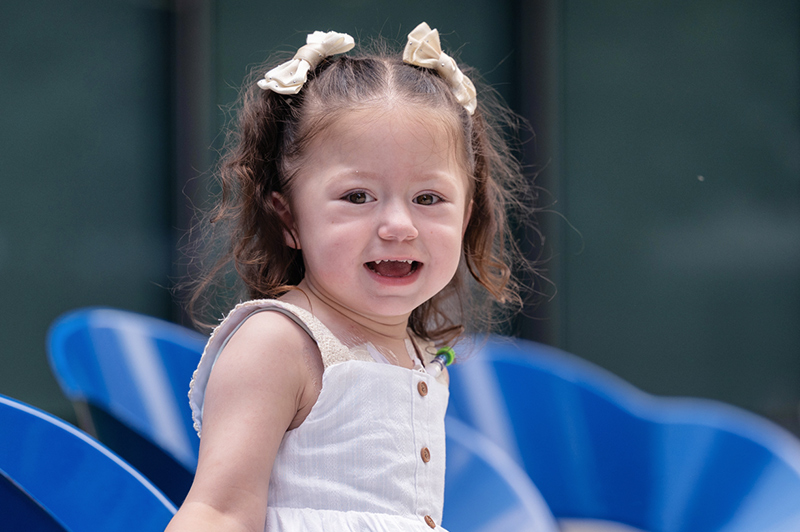
When Jana and Jeffrey noticed that their week-old daughter, Christiana, was throwing up, had a swollen stomach, and was unable to poop, the symptoms seemed awfully familiar — especially to Jeffrey.
“I was treated for Hirschsprung’s disease as a child,” he explains.
This condition occurs when some of the nerve cells in the colon, and sometimes the small intestine, don’t develop properly. This delays the progression of stool through the intestines, and — depending on the amount of small intestine affected — can lead to a form of intestinal failure called short bowel syndrome, in which the body doesn’t have enough small intestine to absorb nutrients.
“I knew right away that something was wrong with Christiana’s health,” explains Jeffrey. While her local doctors initially weren’t concerned, they ultimately referred the family to Boston Children’s — the same hospital Jeffrey was treated at decades earlier.
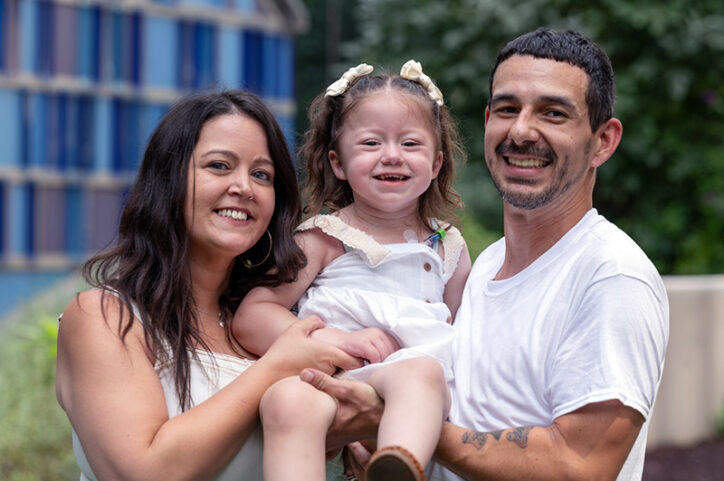
Multidisciplinary care for Hirschsprung’s disease
After arriving at Boston Children’s, Christiana was diagnosed with long-segment Hirschsprung’s disease and, later, short bowel syndrome. All told, she spent four months in the hospital, where she underwent surgeries to remove the affected portions of her intestines. Her surgeon, Dr. Prathima Nandivada, also performed an ileostomy, a procedure in which part of the small intestine is brought through an opening in the abdomen called a stoma. This allows waste to pass though the stoma and into a bag, bypassing the colon and anus. She also had a central line and G-tube placed to deliver nutrition.
“Dr. Nandivada really listened to us and drew pictures to help us understand the procedures,” explains Jana. “We know she’ll also be Christiana’s surgeon for any future operations, which takes away some of the pressure and anxiety.”
Based on his past experiences, Jeffrey thought he knew what came next: years of treatment and frequent long hospitalizations. But those assumptions quickly went out the window when he and Jana learned that Christiana would be seen in the hospital’s Center for Advanced Intestinal Rehabilitation (CAIR).
“It was nothing like the care I received as kid,” he says. Back then, it took years — and many separate appointments — for Jeffrey to get a personalized plan. Now, the process is much smoother: “Christiana has a big team of surgeons, gastroenterologists, nurse practitioners, and social workers and they all work together for her so we don’t have to have lots of smaller appointments with different specialists. It’s fascinating.”
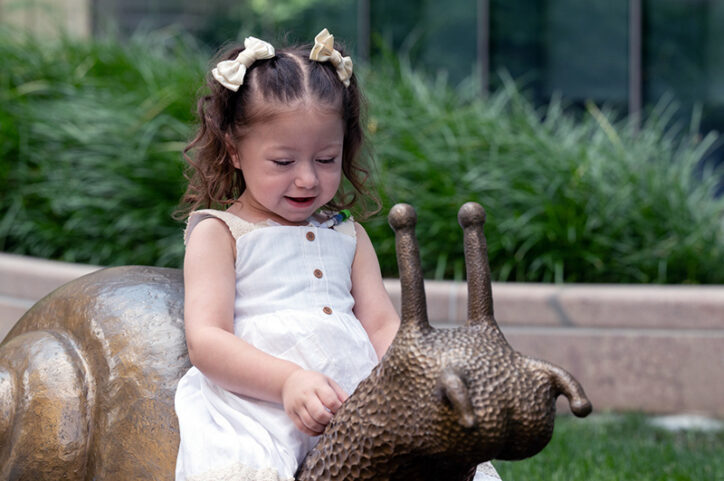
Empowering Christiana — and her parents
Because Christiana, now 3, relies on parenteral nutrition to get the nutrients she needs, nurse Mary Gallotto and others in the Home Parenteral Nutrition Program taught Jana and Jeffrey how to manage that aspect of her care at home. Clinical social worker Ashley Roberge-Boire and her colleagues have helped the family prepare for preschool “every step of the way,” says Jana, who says they feel supported by the whole CAIR team.
“They always call us back right away and no question is too silly,” she says. “They talk to us like people, not just parents of a sick child.” And they use simple, kid-friendly language to explain things to Christiana: “She might be a kid, but this is her body.”
By normalizing her condition, her parents have also empowered her to participate in her own care: She helps with her ostomy bag and central line and knows her schedule for parenteral nutrition.
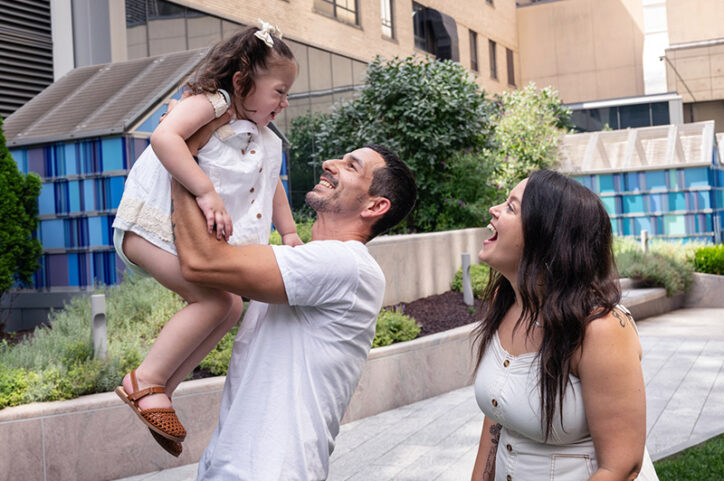
Having her back
Although Christiana has autism and is nonverbal, she’s great at communicating. Like lots of 3-year-olds, she’s a little feisty, stubborn — and very funny. “She’ll look at us for our reaction when she does something ‘bad’ and then run away,” laughs Jana.
She returns to Boston Children’s several times a month for check-ins and never misses the opportunity to say hello to the nurses who cared for her when she was an inpatient. That sense of compassion extends to her classmates and animals: “She’s the sweetest, smartest little girl.”
Three years into their journey, Christiana and her parents “finally have a chance to breathe,” says Jana. “In the beginning, we worried about her so much that we couldn’t focus on anything else. Now we know that Boston Children’s has her back.”
Jeffrey agrees. “They’ve helped us have a life where she doesn’t have to go through what I went through as a kid,” he says. “Every day she proves to us that she’s doing well — and that’s amazing.”
Learn more about our Center for Advanced Intestinal Rehabilitation.
Related Posts :
-

Finding specialized care for short bowel syndrome: Meet Makai
Eric Maldonado was picking up some groceries one day last fall when he saw a familiar face: The woman, a ...
-
Hirschprung's disease won't stop Myles from smiling
Looking at Myles today, you'll see a picture-perfect 1-year-old full of smiles and giggles. He babbles like any other baby ...
-
Doing everything possible for Gabby: A team approach to short bowel syndrome
Gabriel “Gabby” Lopez loves everything hot and spicy. “He will eat a ghost pepper without hesitation,” says his mother, Mayra. “...
-
Then and now: Catching up with some of our short bowel syndrome kids
Also known as “short gut,” short bowel syndrome is a life-threatening condition in which a lack of functioning intestine can ...