Nanoparticle drug combo treats venous malformations
Venous malformations are abnormally shaped veins that develop when the cells lining the blood vessels grow too fast when they aren’t supposed to. Children can be born with them, and as the child grows, the venous malformations can get bigger. Venous malformations are a type of vascular malformation that can range from small and superficial to disfiguring, debilitating, or even life-threatening.
Not satisfied with current treatments, several years ago, critical care physicians Kathleen“Kate” Cullion, MD, PhD, and Daniel Kohane, MD, PhD, director of Boston Children’s Laboratory for Biomaterials and Drug Delivery, wondered if they could develop better treatments. Together with postdoctoral fellow Weimin Tang, PhD, they recently developed nanoparticles that deliver drug treatment directly to venous malformations to help shrink them.
Why do we need new venous malformation treatments?
Venous malformations can affect how a person functions in their day-to-day life and may impede vital functions, like breathing, swallowing, and moving. According to the researchers, they can be very difficult to treat.
Large venous malformations can be too risky to remove surgically, due to the danger of excessive blood loss. In these cases, patients take medications like rapamycin to block cell growth, which also helps prevent venous malformations from enlarging.
Taken regularly, these medications can cause side effects. As a result, some patients stop taking them and the venous malformations continue to grow.
The nanoparticle solution
“Kate and I cared for a patient with a different type of vascular malformation who had a contrast dye study to get a better view of the vessels, and the dye was still in the malformation two months after the study,” says Kohane. “The dye was made up of nanoparticles that usually are not retained in normal blood vessels. The fact that they were retained in this patient suggested that the abnormal vessels were leaky.”
Because of this observation, the researchers wondered whether the same would be true for the vessels that make up venous malformations. And if so, they thought drug-loaded nanoparticles might accumulate in vessels that cause venous malformations.
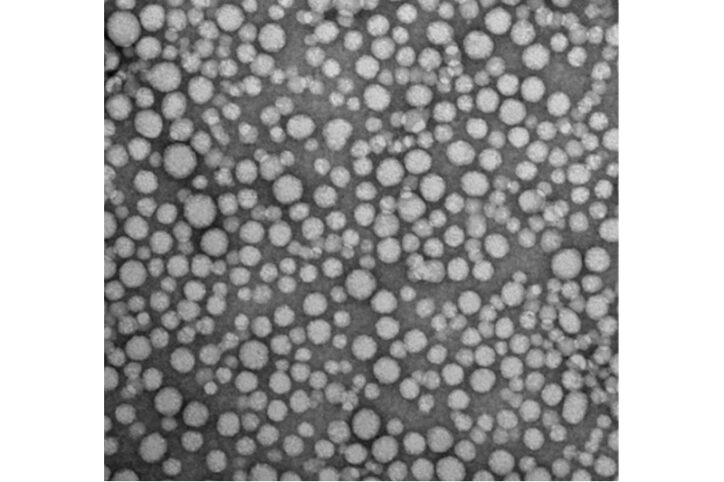
Nanoparticles are extremely small carriers that can be filled with drugs. Here, instead of making a nanoparticle from generic materials that themselves do not have therapeutic effects, Tang, Kohane, and Cullion hypothesized they could create a specially engineered nanoparticle using a new form of rapamycin they developed.
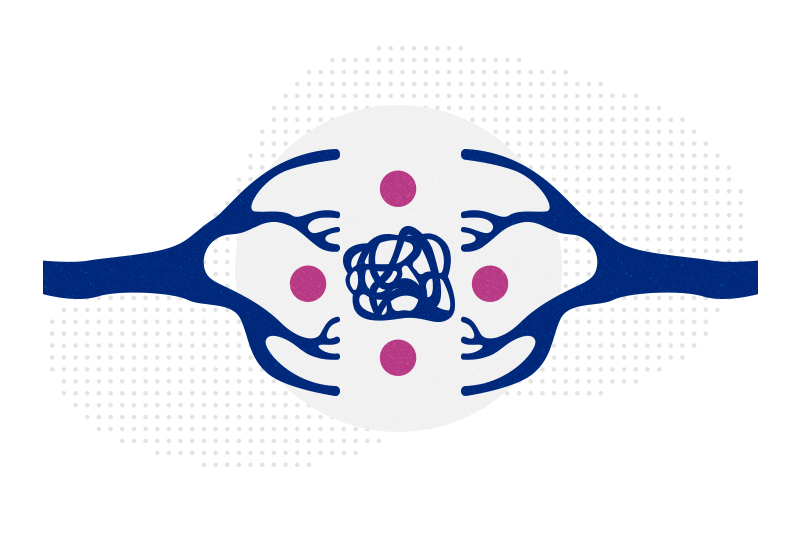
“Instead of giving the medicine rapamycin as individual molecules, we linked many molecules of rapamycin together into a larger structure — almost like turning loose beads into a necklace,” says Cullion. “We then bundled those structures together to make tiny spheres, the nanoparticles.”
Within the nanoparticles are small spaces — like gaps in a ball of tangled necklaces — where we can tuck in other drugs, allowing multiple therapies to be delivered together.” — Kate Cullion, MD
Tang designed the bundled rapamycin, made nanoparticles, and also tucked in the drug ponatinib. He then injected nanoparticles into mouse models of venous malformations and compared them with mice given both medications orally. After 20 days, they saw the greatest effect with the bundled rapamycin nanoparticles with added ponatinib, which reduced the venous malformation size by 70 percent after a single injection.
“What makes these nanoparticles different is that the rapamycin itself is a material from which the nanoparticle is made,” says Tang. “These nanoparticles have rapamycin-like activity without needing to release free molecules of rapamycin. This brand-new formulation could be repurposed for a number of other diseases, as well.”
The team plans to monitor the nanoparticles for longer to see if they continue to shrink the venous malformations or if another injection will be required to completely eliminate them.
Explore more research from the Laboratory for Biomaterials and Drug Delivery.
Related Posts :
-

Targeting treatments for vascular anomalies, courtesy of cancer genetics
Vascular anomalies — overgrowths or malformations of the capillaries, veins, arteries, and/or lymphatic vessels — often confound physicians, especially in acute ...
-
Gold particles and light could melt venous malformations away
Venous malformations — tissues made up largely of abnormally shaped veins — are often difficult to treat, especially when located in sensitive ...
-
Answers for Isaac: A family’s journey to treat vascular anomalies
Early on, Jinah and her husband knew their son Isaac was battling something complex, but they couldn’t figure out ...
-
A safe, pain-specific anesthetic shows preclinical promise
All current local anesthetics block sensory signals — pain — but they also interrupt motor signals, which can be problematic. For example, ...